Good
People.......
I hope Mary Robinson
understands the complexity and brutality of M23
inflicting in Congo and
not favor
Kagame who has been a darling of the UN in the past.
Ideally, as many people
feels, Congo has nothing to discuss with M23.
Kagame who is the owner of
M23 should decide what to do with it and own responsibility to it. The UN should subject M23 to ICC Hague where
Bosco is waiting for them there to answer charges.....To ask Congo to
negotiate with M23 is being mean to Congo. It is like Congo was signed
up for slaughter house where M23 was engineered to exterminate the
Congo people from existance.......which means, who ever brings that
topic that Congo talk to M23 must explain why M23 is Congo problem
and not that of Kagame..........and this will mean the whole world will
have to discuss the matter to save Congo from further inhumanity.
Let the Truth be told
about Congo.........!!!
Judy Miriga
Diaspora Spokesperson
Executive Director
Confederation Council Foundation for Africa Inc.,
USA http://socioeconomicforum50.blogspot.com
Diaspora Spokesperson
Executive Director
Confederation Council Foundation for Africa Inc.,
USA http://socioeconomicforum50.blogspot.com
DR Congo military show off captured rebels
Military forces belonging to the Democratic Republic of Congo have reinforced front-line positions near Goma after their weekend push against M23 rebels.
Congolese officials have paraded several prisoners captured during the fighting.
Three of them were said to be from neighbouring Rwanda which has been accused of backing the rebels.
The M23 rebels, named after a March 23, 2009, peace deal that ended four years of rebellion, took up arms last year accusing the DRC government of failing to honour the agreement which included integrating them into the army.
http://www.euronews.com/2013/09/03/dr-congo-military-show-off-captured-rebels/
UN's Mary Robinson in Goma after surge in DRC fighting
Tuesday 03 September 2013

UN special envoy to the Great Lakes region Mary Robinson (R) flanked by UN special envoy to Congo Martin Kobler (L) address a news conference at the Monusco offices in Goma, eastern Democratic Republic of Congo, 2 September 2013
Reuters/Thomas Mukoya
News / Africa
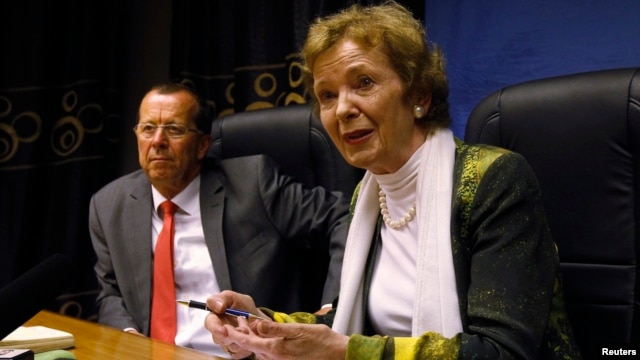 U.N. Special Envoy to the Great Lakes region Mary Robinson (R) flanked by U.N. special envoy to Congo Martin Kobler (L) address a news conference at the MONUSCO offices in Goma, eastern Democratic Republic of Congo, Sept. 2, 2013.
UN Great Lakes Envoy to Address Rwanda Role in DRC Crisis

Special envoy Mary Robinson arrives in Kinshasa

UN special envoy Mary Robinson/AFP
Her visit, which will also take her to neighboring Uganda and Rwanda, follows new attacks on civilians in the country’s east, which has already suffered two decades of conflict.
The former Irish president was greeted on her arrival in the capital by Martin Kobler, head of the UN mission for stabilisation in the DRC (MONUSCO).
MONUSCO said on Sunday that she would travel to eastern city of Goma on Monday to meet representatives of “provincial authorities and civil society” such as trade unions and religious organisations.
Her programme shows that she will spend the week in the region, travelling to Uganda on Wednesday and the Rwandan capital Kigali on Friday.
The visit comes at the same time as the army and Monusco forces have begun an offensive and gained ground against the M23 rebels. The UN claims that the M23 group is funded by Uganda and Rwanda.
Special envoy Mary Robinson arrives in Kinshasa
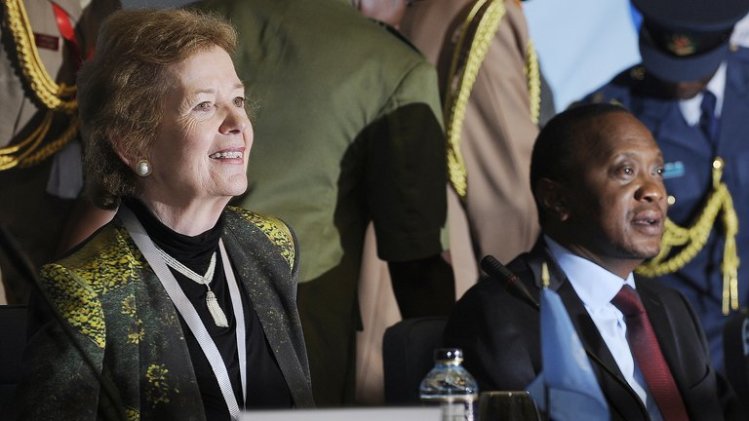
UN special envoy Mary Robinson (L) on July 31, 2013 in
Nairobi. Robinson, the UN special envoy to the African Great Lakes region,
arrived in Kinshasa on Sunday, after warning against an escalation of violence
in the Democratic Republic of Congo's volatile east. (AFP Photo/Simon
Maina)

September 1,
2013
Mary Robinson, the UN special envoy to the African Great Lakes region, arrived in Kinshasa on Sunday, after warning against an escalation of violence in the Democratic Republic of Congo's volatile east.
Her visit, which will also take her to neighbouring Uganda and Rwanda, follows new attacks on civilians in the country's east, which has already suffered two decades of conflict.
The former Irish president was greeted on her arrival in the capital by Martin Kobler, head of the UN mission for stabilisation in the DRC (MONUSCO).
MONUSCO said on Sunday that she would travel to eastern city of Goma on Monday to meet representatives of "provincial authorities and civil society" such as trade unions and religious organisations.
Her programme shows that she will spend the week in the region, travelling to Uganda on Wednesday and the Rwandan capital Kigali on Friday.
The visit comes at the same time as the army and Monusco forces have begun an offensive and gained ground against the M23 rebels. The UN claims that the M23 group is funded by Uganda and Rwanda.
In November, the M23 rebels occupied Goma, the provincial capital of North Kivu, but agreed to pull-out following intense international pressure.
Mary Robinson is responsible for trying to implement a framework agreement, signed in February, to bring about peace in North and South Kivu.
RDC: à Goma, l'ONU appelle
le M23 à "désarmer"
http://www.youtube.com/watch?v=56yPiO5QdNI
UN Special envoy Mary
Robinson arrives in Goma
http://www.youtube.com/watch?v=nEcYJOR20-s
Published on May 1, 2013
The new UN special envoy
for Africa's Great Lakes region, former Irish president Mary Robinson, arrived
in Goma on Tuesday. Robinson who assumed the special envoy role last month, is
tasked with leading political efforts to bring an end to more than two decades
of conflict in the region.
Congo-Kinshasa: Uganda Convenes Meeting to Discuss Congo Crisis
By Moses Odokonyero, 2 September 2013 Photo: Sylvain Liechti/UN
Villagers flee fighting (file photo).
Kampala — Uganda has called an emergency meeting of the extraordinary summit of the International Conference on Great Lakes Region (ICGLR) to discuss the deteriorating security situation in eastern Democratic Republic of Congo (DRC).The meeting scheduled for 5 September in Uganda's capital, Kampala, is expected to be attended by the 11 members of the ICGLR.
"Following the deteriorating situation in the eastern Democratic Republic of Congo, particularly in the recent days resulting in the death and injury of peace keepers from the Force Intervention Brigade, Uganda, as chair of the ICGLR felt it was very urgent to convene an extraordinary summit on 5 September 2013 composed of 11 member states", read a statement released on Saturday by Uganda's ministry of foreign affairs.
The statement said the ICGLR meeting is an attempt by member states to bring parties in the conflict to the round table for a lasting peace in not only the DRC but also the Great Lakes region as a whole.
Last week witnessed fierce fighting between the M23 rebels and the DRC army supported by a UN brigade mandated to use force.
The United Nations and the DRC accuse Rwanda of supporting the M23 rebels. Rwanda denies the charge, saying lawless eastern Congo is used as a haven for rebels fighting the Kigali government.
Uganda on the other hand is fearful of a further influx of Congolese refugees putting its already strained public facilities under even more pressure. In July, 67,000 Congolese fled into Uganda following outbreak of violence in eastern Congo prompting Uganda's foreign ministry to say it was "alarmed by the influx".
Despite the rebels announcing a ceasefire on Friday last week, media reports say there was renewed fighting in eastern Congo over the weekend.
A UN brigade, which has been fighting alongside the Congolese army, says it was not involved in the weekend fighting.
-----
Forwarded Message -----
From: Augustine Rukoma
To: mabadilikotanzania@googlegroups.com
Sent: Tuesday, September 3, 2013 2:03 PM
Subject: Re: [Mabadiliko] Robinson ataka DRC izungumze na M23
Huyu mama vipi tena! Mazungumzo ya nini, watusi warudi kwao
banyamulenge wajisalimishe wakajibu mashtaka
On 9/3/13, Katulanda Frederick <fkatulanda@gmail.com> wrote:
Kauli ya Mjumbe Maalumu wa Katibu Mkuu wa Umoja wa Mataifa katika Kanda ya
Maziwa Makuu, Marry Robinson, anayekamilisha ziara yake katika mji wa Goma
ya kutaka Kongo izungumze na M23 haikupokewa vyema.
Akizungumza na waandishi wa habari katika mji wa Goma,
hasa akigusia swala
la mapigano baina ya waasi wa M23 na jeshi la serikali ya Kongo likiungwa
mkono na kikosi maalumu cha Umoja wa Mataifa kilichopewa jukumu la
kuingilia kati katika mapigano, Bi Robinson alisema vita hivyo
vimezipunguza nguvu za M23 na kwamba wakati umewadia waasi hao kuweka chini
silaha, na kwenda kwenye meza ya mazungumzo
la mapigano baina ya waasi wa M23 na jeshi la serikali ya Kongo likiungwa
mkono na kikosi maalumu cha Umoja wa Mataifa kilichopewa jukumu la
kuingilia kati katika mapigano, Bi Robinson alisema vita hivyo
vimezipunguza nguvu za M23 na kwamba wakati umewadia waasi hao kuweka chini
silaha, na kwenda kwenye meza ya mazungumzo
''Ni dhahiri kwamba M23 wanapaswa kusimamisha mashambulizi kama
ilivyotakiwa katika Azimio la Baraza la Usalama la Umoja wa Mataifa, na pia
nadhani kwamba mlango uko wazi kwa uwezekano wa kuchukuliwa hatua za
kisiasa kuumaliza mgogoro huu."
Akijibu swali kuhusu ikiwa anaweza kuwa muwazi mbele ya viongozi wa Rwanda
juu ya shutuma dhidi ya serikali ya Kigali kuwa inawaunga mkono waasi wa
M23, Bi Robinson alisema atakwenda Kigali baada ya Kampala hapo tarehe 5
Septemba na kurudi Goma tarehe 6 Septemba pamoja na wenzake.
"Mimi sina shida ya kuzungumza moja kwa moja na viongozi wa Rwanda" kwani
aliongeza Bi Robinson aliongeza kwamba Rwanda inamfahamu vizuri tangu
alipoitembelea nchi hiyo kama rais wa Ireland.
"Nadhani kuwa ni muhimu kwa kila upande uliosaini mkataba wa Addis Ababa
kuuheshimu na hivyo katika kanda hii. Nitalitamka hilo bila uoga kwa marais
wote akiwemo Rais Paul Kagame. Naelewa kuwa kuna uwoga hapa kutokana na
kuwa karibu na eneo hili kwa jeshi la Rwanda. Hilo nitalijadili na Rais
Kagame.''
Kivu ya
Kaskazini wakasirishwa
<http://www.dw.de/robinson-ataka-drc-izungumze-na-m23/a-17062014?maca=kis-newsletter_kis_programm-1967-html-newsletter#>
Mary Robinson
Kwa upande wake. Gavana wa Mkoa wa Kivu ya Kaskazini, Julien Paluku
Kahongya, akizungumza na waandishi wa habari baada ya kufanya mazungumzo na
Bi Robinson, alisema kwamba haoni umuhimu tena wa kuendelea kwa mazungumzo
ya Kampala.
"Kufuatia vitendo vya awali vya M23 na tulivyokuwa tunavitangaza, na kwamba
inatupa mabomu katika miji mikubwa kama vile Goma na Gisenyi, hilo kwa
sheria ya kimataifa ni ukatili wa kivita. Na sioni kwa upande wa Umoja wa
Mataifa ambao wanaheshimu vyombo vya kimataifa kuiomba serikali halali kama
vile ya Kongo kuzungumza na wahalifu."
Mwandishi: John Kanyunyu/DW Beni
Mhariri: Saumu Yusuf
The Talk'
Frederick M. Katulanda
Cell: +255 784 642620,
Alternative:+255 754 642620
E-mail: fkatulanda@yahoo.com
News / Africa
Goma Residents Hopeful Rebel Withdrawal Spells Peace in Eastern Congo

September 01, 2013
GOMA — Residents of Goma, in the eastern Democratic Republic of Congo, are optimistic that the withdrawal of M23 rebels from positions outside the city could bring an end to fighting in the area. The situation is still volatile, as tensions with neighboring Rwanda remain high.
Days after the shelling stopped, the Virunga market in Goma is starting to shuffle back to life.
It’s Sunday - a typically slow day - but many of the shops here are open. Women are folding colorful fabrics, and customers are walking through rows of used blue jeans hanging from wooden posts.
Serges Chivai, a shopkeeper on the edge of the market, is just packing away the flashlights and plastic toys displayed in his stall. He says business is going well, at least compared to the last week. “Last week the atmosphere was really bad,” he said, “because bombs were being dropped, people were running away, people were afraid, that’s why the work really could not go well.”
The merchants and customers here tell similar stories, of bomb blasts and panic for nearly two weeks, as the Congolese army and a U.N. intervention force battled M23 rebels on the outskirts of the city.
Artillery shells fell around Goma, the capital of North Kivu province, including one near the market.
On Friday, M23 announced it is withdrawing from areas just north of the city.
Delphine, an 18-year-old merchant hanging colorful cloth in the center of the market, says she hopes the withdrawal signals that the end of the fighting could be near." "We want the government to finish the war,” she says, “then we can get clients to buy our fabrics and we can live peacefully," she said.
Despite the rebels’ pullback, fighting continued Saturday deeper into M23-held territory, as the army has shown few signs of letting up.
The latest round of fighting also has disrupted Rwanda, after shells exploded across the border during fighting last week, killing at least one person. The incident prompted angry accusations between the two countries, with both saying the missiles were launched from the other’s territory.
Rwanda, which has accused the U.N. mission in DRC (MONUSCO) of turning a blind eye to past cross-border bombings, has called the latest shelling into Rwandan territory a “provocation.”
The U.N. special representative who heads MONUSCO, Martin Kobler, met with Rwandan officials last week to try to ease tensions and to explain the role of the new U.N. intervention brigade, which lived up to its aggressive mandate to attack M23 positions.
In Goma Saturday, Kobler told reporters, “I made it very clear this is for the protection of the civilian population of Goma, this is the core of our mandate, this is what we’re here for, we could not have remained passive in this situation where M23 rockets hit the population of Goma and caused deaths.”
The U.N. has presented evidence of Rwandan military links to the M23, and the United States has called on Rwanda to cease its support for the rebels. Kigali has repeatedly denied the accusations.
Days after the shelling stopped, the Virunga market in Goma is starting to shuffle back to life.
It’s Sunday - a typically slow day - but many of the shops here are open. Women are folding colorful fabrics, and customers are walking through rows of used blue jeans hanging from wooden posts.
Serges Chivai, a shopkeeper on the edge of the market, is just packing away the flashlights and plastic toys displayed in his stall. He says business is going well, at least compared to the last week. “Last week the atmosphere was really bad,” he said, “because bombs were being dropped, people were running away, people were afraid, that’s why the work really could not go well.”
The merchants and customers here tell similar stories, of bomb blasts and panic for nearly two weeks, as the Congolese army and a U.N. intervention force battled M23 rebels on the outskirts of the city.
Artillery shells fell around Goma, the capital of North Kivu province, including one near the market.
On Friday, M23 announced it is withdrawing from areas just north of the city.
Delphine, an 18-year-old merchant hanging colorful cloth in the center of the market, says she hopes the withdrawal signals that the end of the fighting could be near." "We want the government to finish the war,” she says, “then we can get clients to buy our fabrics and we can live peacefully," she said.
Despite the rebels’ pullback, fighting continued Saturday deeper into M23-held territory, as the army has shown few signs of letting up.
The latest round of fighting also has disrupted Rwanda, after shells exploded across the border during fighting last week, killing at least one person. The incident prompted angry accusations between the two countries, with both saying the missiles were launched from the other’s territory.
Rwanda, which has accused the U.N. mission in DRC (MONUSCO) of turning a blind eye to past cross-border bombings, has called the latest shelling into Rwandan territory a “provocation.”
The U.N. special representative who heads MONUSCO, Martin Kobler, met with Rwandan officials last week to try to ease tensions and to explain the role of the new U.N. intervention brigade, which lived up to its aggressive mandate to attack M23 positions.
In Goma Saturday, Kobler told reporters, “I made it very clear this is for the protection of the civilian population of Goma, this is the core of our mandate, this is what we’re here for, we could not have remained passive in this situation where M23 rockets hit the population of Goma and caused deaths.”
The U.N. has presented evidence of Rwandan military links to the M23, and the United States has called on Rwanda to cease its support for the rebels. Kigali has repeatedly denied the accusations.
http://www.voanews.com/content/goma-residents-hopeful-rebel-withdrawal-peace-drc-congo/1741391.html


No comments:
Post a Comment