Wednesday, May 20, 2015

Investors should work with farmers, not grab their land


Investors should work with farmers, not grab their land

Industrialised countries should do more to persuade companies that investing in, and working with, farmers makes more business sense than buying their land
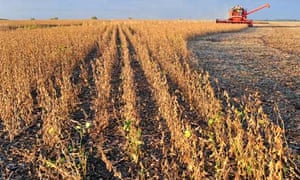
A combine harvests soybeans near Salto, Argentina
Soybeans harvested in Argentina. Farmers are the largest investors in agriculture – and the majority of the world's poor. Photograph: Bloomberg via Getty Images
Land grabbing has become a hot topic in the international development community and beyond. The term usually refers to the acquisition of large areas of land by powerful investors, without respecting the rights and interests of the local users like farmers, herders and foresters.
Estimates vary widely because of the difficulty of collecting reliable data, but it can be assumed that at least 30m hectares have been targeted by large-scale land transactions over the past decade.
While not all large-scale land acquisitions can be defined as land grabbing, research by the Food and Agriculture Organisation (FAO) shows they carry risks for local communities and their environment, especially in countries where governance is weak and land rights unclear. Displacement of small farmers, loss of incomes and livelihoods for rural people and depletion of productive resources are all reported, with consequences including increased poverty and food insecurity, social fragmentation and conflicts.
The land rush was fuelled by the food price hike of 2007-08 – wealthier countries with a food deficit tried to secure supplies by buying land in developing countries with abundant natural resources. Other factors were the rise of biofuels and portfolio diversification by investors worried by the fall of real estate, equity and bond markets.
But the land grabbing phenomenon is also a reflection of an investment gap in developing country agriculture that has persisted for decades. Filling that gap with productive investment is urgently needed to stop land grabbing and reduce hunger and poverty.
The world faces the formidable challenge of feeding a population that will exceed 9 billion in 2050. Today, one person in eight suffers from chronic hunger. To eradicate hunger and reduce poverty, the FAO estimates that more than $80bn (£49.8bn) per year of net investments in agriculture in developing countries are needed. Achieving the goal in a sustainable manner that preserves natural resources will cost even more.
Advertisement
Farmers are the largest investors in agriculture, far ahead of any other sources. They also constitute the majority of the world's poor. Helping them invest more is essential to meet the twin challenge of feeding the world and reducing poverty. To this end, governments should put in place supportive policies and invest in key public goods such as infrastructure, education and agricultural research and development.
Even then, farmers and governments will struggle to meet the enormous investment needs. Businesses also have an important role to play. They can contribute to increasing the productivity of agriculture in many ways such as transfer of technology, value addition and more efficient management. But unfortunately not all corporate investments will have this positive effect. So the question is: what type of investment is more likely to increase agricultural productivity and reduce hunger?
FAO research shows that investments that involve local farmers as equal business partners, leaving them in control of their land, have the most positive effects on local development. In Zambia, for example, a partnership between a co-operative of farmers producing sugar cane and a processing company gives farmers shares in the company and representation on its board. Inclusive investments combine the strengths of the investor with those of local farmers. The investor brings capital, technology and expertise in management and marketing, while farmers provide labour, land, traditional know-how and knowledge of local conditions.
However, to succeed, inclusive investments may still need external support to build the investor-farmers relationship. They also need "patient capital", as financial returns are unlikely to materialise in the first years. Above all, they need supportive policies, laws and institutions, but these are often missing in developing countries. Their governments should improve the investment climate and give priority to inclusive investments.
At their summit in Lough Erne, G8 leaders promised to help developing countries improve land governance, including by implementing the guidelines on the governance of tenure adopted by the Committee on World Food Security last year.
This is good news. G8 countries are home to many of the world's largest investors. They should give them clear incentives to apply internationally recognised standards for responsible investment. And encourage them to invest with farmers, rather than purchase vast tracts of land which are then often left idle.
Sensible investors do not look for profit only, they want sustainable profit. They can be persuaded that investing with farmers makes more business sense than investing in their lands.
• Pascal Liu is a senior economist at the Food and Agriculture Organisation

Land grabbers: Africa's hidden revolution


Land grabbers: Africa's hidden revolution

Vast swaths of Africa are being bought up by oligarchs, sheikhs and agribusiness corporations. But, as this extract from The Land Grabbers explains, centuries of history are being destroyed

Ethiopia rice farming
Employees of Saudi Star work in a rice paddy in Gambella, Ethiopia. The government wants to resettle thousands of families away from fertile land. Photograph: Jenny Vaughan/AFP/Getty Images

Omot Ochan was sitting in a remnant of forest on an old waterbuck skin and eating maize from a calabash gourd. He was lean and tall, wearing only a pair of combat pants. Behind him was a straw hut, where bare-breasted women and barefoot children cooked fish on an open fire. A little way off were other huts, the remains of what was once a sizable village. Omot said he and his family were from the Anuak tribe. They had lived in the forest for 10 generations. "This land belonged to our father. All round here is ours. For two days' walk." He described the distant tree that marked the boundary with the next village. "When my father died, he said don't leave the land. We made a promise. We can't give it to the foreigners."
Our conversation was punctuated by the rumble of trucks passing on a dirt road just 20 metres away. The dust clouds they created wafted into the clearing and rained down on the leaves on the trees. Beyond the road huge earth-diggers were excavating a canal. Omot watched them: "Two years ago, the company began chopping down the forest and the bees went away. The bees need thick forest. We used to sell honey. We used to hunt with dogs too. But after the farm came, the animals here disappeared. Now we only have fish to sell." And with the company draining the wetland, the fish will probably be gone soon, too.
Gambella is the poorest province in one of the world's poorest nations – a lowland appendix in the far south-west of Ethiopia. Geographically and ethnically, the hot, swampy province feels like part of the new neighbouring state of South Sudan, rather than the cool highlands of the rest of Ethiopia. Indeed, Gambella was effectively in Sudan when it was ruled by the British from Khartoum, until 1956. For the half-century since, the government in Addis Ababa has ruled here, but it has invested little and cared even less for its Nilotic tribal inhabitants, whose jet-black skin and tall, elegant physique mark them out from the highlanders. The livestock-herding Nuer, who frequently cross into South Sudan, and the Anuak, who are farmers and fishers, are peripheral to highland Ethiopia in every sense.
Only three flights a week go to the provincial capital, also called Gambella. When you get there, there are no taxis, because there is no demand. The road from the airport is a dirt track through an empty landscape. Gambella town is a shambles. Its population of 30,000 has no waste collection system, so garbage piles up. The drains don't work, public water supplies are sporadic and electricity is occasional. There are few public latrines. The couple of paved roads are heavily potholed and give out before the town limits. My billet, the Norwegian-built guest house at the Bethel Synod church, was probably the dirtiest, bleakest and most ill-kempt building in which I have ever rested my head. The only vehicle in town for hire was a 40-year-old Toyota minibus of dubious roadworthiness, with a crew of three. I took it.
Advertisement
Of late, the central government in Addis Ababa has stopped pretending that the province of Gambella doesn't exist. It now seems intent on taming a populace that might prefer rule from Juba, the capital of South Sudan. In practice, that means bringing in foreign agribusiness and collecting the province's dispersed population in state-designated villages, while their forests, fields and hunting grounds are handed over to outsiders. In the service of capitalism, the Gambella "villagisation" programme will relocate a domestic population much in the manner of Stalin, Mao and Pol Pot.
I set out along the only road south from Gambella town to find the land grabbers. On the outskirts, as we hit the dirt, my driver decided to pick up a dozen hitchhikers. From then on, we were the local bus service. To an outsider, much of the province looks deserted. For miles, the only obvious sign of human activity was the odd cellphone tower, usually with a generator to power it and a native guard. But there were hidden villages in the bush. Their members would sit by the roadside trying to sell mangoes and other fruit to any vehicles that passed. Mangoes cost less than three cents each and the price had halved by late afternoon. Soon after the small town of Abobo, the road passed through a landscape of ash, smoke and charred trees. This was land newly acquired by my first land grabber – Sheikh Mohammed Hussein Ali Al Amoudi, a Saudi oil billionaire with large holdings in Ethiopian plantations, mines and real estate. In 2011, Fortune magazine put his wealth at more than $12bn. Ethiopian-born, he is a million-dollar donor to the Clinton Foundation and also a confidant of Ethiopia's prime minister, Meles Zenawi, and his ruling party, which had granted a 60-year concession on 10,000 hectares of Gambella to Amoudi's company, Saudi Star.
Amoudi has been eyeing agriculture since the world food price spike in 2008 sent Saudi Arabia into a spin about its food supplies. He is intent on shipping most of his intended produce, including in excess of a million tonnes of rice a year, to Saudi Arabia. There, he has been feted by the king for making investments abroad to keep the kingdom fed. To smooth the wheels of commerce, Amoudi has recruited one of Zenawi's former ministers, Haile Assegdie, as chief executive of Saudi Star.
Saudi Star's concession is based around the Alwero dam, built in the 1980s to irrigate a state cotton farm that never happened. The dam's rusting sign still advertises the consulting services of Soviet engineers Selkhozpromexport. Amoudi is digging a 30km canal from the dam to irrigate rice paddies. Once the old state farm is watered, he wants to expand to at least 250,000 hectares, to grow sunflowers and maize.
At the gate of the Saudi Star compound, I watched soldiers usher in giant Volvo trucks and Massey Ferguson tractors and workmen starting to replace the temporary buildings with new permanent structures. Close by, they were laying an airstrip in a recently made clearing in the forest. Nobody at the company here or in Gambella town would talk to me. Perhaps they thought there was nothing to add to their boss's media statement that "land grabbing poses no harm on the environment or on the local community".
Our next hitchhikers were a couple of schoolgirls who wanted a lift to their home 2km away. It was there, in a small clearing in a forest by the road, where we found Omot Ochan in his combat pants, describing how Amoudi and his company were destroying his world. Hearing his testimony of ancestral connection with this patch of forest, and his determination to keep it, I was struck by how most westerners have lost any sense of place and attachment to the land. I move around all the time and buy and sell houses without feeling ties to the soil. But here in Gambella, their land is like their blood. It is everything. And to lose it would be to lose their identity.
Omot insisted Saudi Star had no right to be in his forest. The company had not even told the villagers that it was going to dig a canal across their land. "Nobody came to tell us what was happening." He did remember officials from the "villagisation" programme dropping by to say the families should go to the new village at Pokedi, across the River Alwero from Saudi Star's compound. But that was all. Omot had no doubt the purpose of the new village was to clear them and others off land taken from them to give to Saudi Star. So far, his family and their neighbours had refused to go, even though their children walked to the school at Pokedi on a Monday morning and didn't return until Friday evening.
"In our culture, going to a different place is unusual. You get different people and there is quarrelling," he told me, as his children gathered and grabbed the remaining maize. "We should remain in our own area. We won't go unless we are forced. God gave us this land." Another truck rumbled past, spraying dust over the tiny forest community now ostracised by its own government and under siege from a Saudi billionaire. After the truck had gone, I noticed a large, dead stork in the road. A woman headed off down the road with a bucket, on a long walk to find water.

STOP AFRICA LAND GRAB FOR THE COUNCIL OF GLOBAL RICH


The African people face an existential threat. With the enthusiastic support of some African governments, foreign countries and companies and wealthy foreigners are rapidly taking over the productive lands in Africa and turning Africans into refugees and slave laborers in their own homeland.

Land grabbing is the contentious issue of large-scale land acquisitions; the buying or leasing of large pieces of land in developing countries, by domestic and transnational companies, governments, and individuals. While used broadly throughout history, land grabbing as used today primarily refers to large-scale land acquisitions following the 2007-2008 world food price crisis. By prompting food security fears within the developed world and newfound economic opportunities for agricultural investors and speculators, the food price crisis caused a dramatic spike in large-scale agricultural investments, primarily foreign, in the Global South for the purposes of food and biofuels production. Initially hailed by investors and some developing countries as a new pathway towards agricultural development, investment in land has recently been criticized by a number of civil society, governmental, and multinational actors for the various negative impacts that it has had on local communities.
The target locations of most land grabs are in the Global South, with 70% of land grabs concentrated in Sub-Saharan Africa. Other primary areas of note are in Southeast Asia and Latin America.

Land Grabbing in Africa: a Review of the Impacts and the Possible Policy Responses a research funded by the Pan Africa Programme of Oxfam International, conducted by Tinyade Kachika, Senior researcher.

The research highlights issue such as:
  • The Rise of Land Deals in Sub-Saharan Africa
  • Land Grabbing and Risk for Small Scale Farmers,
  • Land Grabs: Another Yoke over Women’s Land Rights?
  • Opportunity for Groups at Risk: The African Union’s Continental Standards on Land Question
Click here to view PDF document for Land Grabbing in Africa: a Review of the Impacts and the Possible Policy Responses\

Food Crisis and the Global Land Grab – a website, dedicated mainly to news reports about the global rush to buy up or lease farmlands abroad as a strategy to secure basic food supplies or simply for profit

Farmlandgrab.org, a website, dedicated mainly to news reports about the global rush to buy up or lease farmlands abroad as a strategy to secure basic food supplies or simply for profit. Its purpose is to serve as a resource for those monitoring or researching the issue, particularly social activists, non-government organisations and journalists.

Hedge funds 'grabbing land' in Africa


Hedge funds 'grabbing land' in Africa

  • 8 June 2011
  • From the section Africa
Foreign firms are snapping up farming land in Africa, a new report says
Hedge funds are behind "land grabs" in Africa to boost their profits in the food and biofuel sectors, a US think-tank says.
In a report, the Oakland Institute said hedge funds and other foreign firms had acquired large swathes of African land, often without proper contracts.
It said the acquisitions had displaced millions of small farmers.
Foreign firms farm the land to consolidate their hold over global food markets, the report said.
They also use land to "make room" for export commodities such as biofuels and cut flowers.
"This is creating insecurity in the global food system that could be a much bigger threat than terrorism," the report said.
The Oakland Institute said it released its findings after studying land deals in Ethiopia, Tanzania, South Sudan, Sierra Leone, Mali and Mozambique.
'Risky manoeuvre'
It said hedge funds and other speculators had, in 2009 alone, bought or leased nearly 60m hectares of land in Africa - an area the size of France.
"The same financial firms that drove us into a global recession by inflating the real estate bubble through risky financial manoeuvres are now doing the same with the world's food supply," the report said.
It added that some firms obtained land after deals with gullible traditional leaders or corrupt government officials.
"The research exposed investors who said it is easy to make a deal - that they could usually get what they wanted in exchange for giving a poor tribal chief a bottle of Johnnie Walker [whisky]," said Anuradha Mittal, executive director of the Oakland Institute.
"When these investors promise progress and jobs to local chiefs it sounds great, but they don't deliver."
The report said the contracts also gave investors a range of incentives, from unlimited water rights to tax waivers.
"No-one should believe that these investors are there to feed starving Africans.
"These deals only lead to dollars in the pockets of corrupt leaders and foreign investors," said Obang Metho of Solidarity Movement for New Ethiopia, a US-based campaign group.
However, not all companies named in the report accept that their motives are as suggested and they dismiss claims that their presence in Africa is harmful.
One company, EmVest Asset Management, strongly denied that it was involved in exploitative or illegal practices.
"There are no shady deals. We acquire all land in terms of legal tender," EmVest's Africa director Anthony Poorter told the BBC.
He said that in Mozambique the company's employees earned salaries 40% higher than the minimum wage.
The company was also involved in development projects such as the supply of clean water to rural communities.
"They are extremely happy with us," Mr Poorter said.

Court orders State Dept to release Clinton emails


MSNBC: Hillary Clinton's Use Of Personal Email At State Dept "Staggering" And "Shocking"

https://www.youtube.com/watch?v=5nvi5YKWg08


Court orders State Dept to release Clinton emails


Washington (AFP) - A US judge ordered the State Department on Tuesday to promptly release thousands of emails from Democratic presidential hopeful Hillary Clinton, dating back to her time as America's top diplomat.
In his ruling, US District Judge Rudolph Contreras ordered that the hub of US global diplomacy must come up with a "schedule for rolling productions of Secretary Clinton's emails" by next Tuesday, a State Department official said.
"We take our legal obligations seriously. We'll comply with the order," the agency's press office director Jeff Rathke told reporters.
Clinton meanwhile renewed her calls for the emails to be made public, saying: "No one has a bigger interest in getting them released than I do."
The row has heated up after it was revealed earlier this year that the former first lady had eschewed using a State Department email address during her four-year tenure, instead sending and receiving all her email correspondence on a private server.
Clinton said she had handed over every email relevant to her job as secretary of state and destroyed all the rest, which she maintained were personal, dealing with such matters as her daughter's wedding, her yoga classes and her mother's funeral.
But the revelations have played into long-held Republican criticism that she and her husband, former president Bill Clinton, are unnecessarily secretive.
And the suspicions could well stalk her as the clock ticks down to the 2016 elections.
- Foreign governments -
In March, the State Department set up a special internal team to review every single email and black out any classified material.
But Contreras shot down a request from the diplomatic behemoth to be given until January 2016 to complete its internal review of some 30,000 emails, amounting to about 55,000 pages.
"The department understands the considerable public's interest in these records and is endeavoring to complete the review and production of them as expeditiously as possible," John Hackett, the State Department's acting director of the Office of Information Programs, wrote in his court filing.
"The collection is, however, voluminous," he wrote, saying it presented "several challenges" some of which needed Washington to possibly consult with foreign governments.
Rathke confirmed the State Department had "originally proposed" releasing all the emails on mass in January once the review was finished.
Clinton stressed the emails sent on the private address hdr22@clintonemail.com during her tenure as secretary of state from 2009 to 2013 belonged to the State Department.
"They have their process that they do for everybody, not just for me. But anything they might do to expedite that process, I heartily support," she said, during a campaign stop in Iowa.
"I want the American people to learn as much as we can about the work that I did with our diplomats and our development experts because I think it will show how hard we worked and what we did for our country during the time that I was secretary of state."
Clinton is the clear frontrunner for the 2016 Democratic Party nomination, with only independent Senator Bernie Sanders having also officially announced his candidacy for the White House job.
Former senators Jim Webb and Lincoln Chaffee, as well as ex-Maryland governor Martin O'Malley, are reportedly also mulling runs.
Rathke confirmed Clinton's emails relating to the 2012 attacks on the US diplomatic mission in Benghazi, Libya, in which four Americans were killed, would be the among the first released.
They would account for some 300 emails amounting to about 900 pages.


 ===================

Judge considers 'rolling' release of Hillary Clinton emails

Updated 12:56 PM ET, Tue May 19, 2015

Washington (CNN)U.S. District Court Judge for the District of Columbia Rudolph Contreras asked the State Department to file a notice that would include a proposed deadline for the release of Hillary Clinton's emails, as well as a new proposal for a schedule that involves releasing documents on a rolling basis.
A lawyer for journalist Jason Leopold, who has filed a Freedom of Information Act request seeking all the emails Clinton turned over from her private server, told the judge he wanted the Benghazi emails "produced immediately" and requested that the other emails — some 55,000 pages — be released on a rolling basis. He also asked for periodic updates on the production.
The government had stated in their filings to the court that it would complete a review of thousands of pages of by Jan. 15, 2016, according to papers in an ongoing Freedom of Information lawsuit, suggesting that the full release of documents wouldn't come out until next year.
"The Department understands the considerable public's interest in these records and is endeavoring to complete the review and production of them as expeditiously as possible," wrote John F. Hackett , the acting Director of the Office of Information Programs and Services at the State Department, in the Court declaration.
On Tuesday, Contreras seemed amenable to the request for a rolling release, telling the government that it didn't sound "unreasonable". At one point the judge asked, isn't "rolling production the norm?"
When the State Department's lawyer talked about its detailed process of the review the judge responded, you "can't let the perfect be the enemy of the good."
"Given the volume of the records, its not unreasonable for the department to ask for a deadline of January 2016 to complete the entire review, but we do think its unreasonable for them to withhold all of the records until that date, which is why we requested a rolling production, and we are happy that the judge appears ready to adopt a rolling production in this case," Leopold's lawyer, Ryan Steven James, said following the hearing.
The State Department's lawyer said that the Benghazi emails would be posted "soon" suggesting it could occur in weeks or days.
Hackett said that after the review is completed, the plan is to post the releasable portions on the Department's website. He said that in December 2014, Clinton provided approximately 30,000 emails, comprising approximately 55,000 pages in response to a letter sent by the Department of State to former Secretaries requesting emails "sent or received on a personal email account."
The documents arrived in twelve "bankers' boxes with labels placed on the outside of the boxes that corresponded approximately to the timeframe of the documents in the box. The Department conducted a page by page review of the documents in consultation with the National Archives Records Administration.
Hackett said that a separate review was conducted on a "date-limited" portion of the 55,000 pages to locate any that were responsive to requests of the House Select Committee on Benghazi. "As a result of that manual review, the Department located and produced to the House Select Committee 296 emails composed of approximately 850 pages."
In the coming weeks and months the review will require consultation with other agencies, as well as "potentially with foreign governments".
Citizens United, a public interest group with several pending FOIA lawsuits, hopes the proposed deadline does not interfere with document productions for their cases concerning key Clinton associates, the Benghazi controversy as well as information concerning The Clinton Foundation.
"When we asked for these records a year ago, we fully expected the Clinton Foundation's relationship with the State Department to be a central issue of the presidential election in 2016," said David Bossie the President of the group.
"We fully expect to receive some of Secretary Clinton's emails that have been in question for several months," he said.
The staff is comprised of a project manager, two case analysts, as well as nine FOIA reviewers as well as other specialists who have met daily since April.
In detailing the Department's plan Hackett wrote,"this will make the maximum number of records available to the public in the shortest amount of time, and will be considerably more efficient than reviewing the documents piecemeal, in response to multiple subject-specific FOIA requests. "


==============


Judge Calls For "Rolling" Release Of Hillary Clinton's Emails

Judge Calls For
Rejecting a State Department proposal to release all of Hillary Clinton's emails at once next January, a federal judge has called for the documents to be released over time.
U.S. District Court Judge Rudolph Contreras ordered the "rolling production" of the documents in response to a Freedom of Information Act lawsuit filed by VICE News.
Contreras said the State Department needs to submit a schedule for the periodic release of the emails by next Tuesday.
The judicial order also calls on the State Department to propose a deadline for the production of 300 emails related to the terrorist attack on U.S. facilities in Benghazi in 2012.
The Benghazi emails have been provided to the House committee investigating the attack but have not been made available to the public.
In a court filing Monday night, the State Department had proposed releasing all of Clinton's emails to the public in mid-January of next year.
The filing noted the process of reviewing 55,000 pages of communications is labor intensive and time consuming, with analysts reviewing about 1,000 emails a week.

The State Department has previously pledged to release the emails related to Benghazi "soon" but has not provided a specific date.
Clinton, the front-runner for the Democratic presidential nomination in 2016, has said the State Department should release her emails as soon as possible.
She has maintained that she did not break any rules by using a private server and domain for her official business during her tenure as Secretary of State.
Clinton said she used the private email account for convenience but acknowledged that it would have been better to use a second email account and a second phone.
by RTT Staff Writer
For comments and feedback: editorial@rttnews.com
 

MSNBC: Hillary Clinton's Use Of Personal Email At State Dept "Staggering...

Hillary Clinton Answers Questions on Iraq, Emails, the Foundation and Wealth


Hillary Clinton Answers Questions on Iraq, Emails, the Foundation and Wealth


Political News, Now.
 
Photo
Hillary Rodham Clinton addressed reporters' questions on Tuesday after participating in a discussion with small-business owners in Cedar Falls, Iowa.Credit Stephen Crowley/The New York Times
CEDAR FALLS, Iowa — Hillary Rodham Clinton addressed reporters Tuesday, fielding questions on topics ranging from her personal wealth and her family’s foundation to the deteriorating situation in Iraq, saying at one point that she had “made a mistake” as a United States senator in voting to authorize the war in Iraq.
Mrs. Clinton, who has been criticized for weeks by Republicans and members of the national news media for her unwillingness to engage with the political press corps, approached journalists and answered five questions after a round-table discussion in Cedar Falls focusing on small business creation.
“I am so proud of the foundation,” Mrs. Clinton said in response to a question about the controversy surrounding foreign donations to the Clinton Foundation. “I’ll let the American people make their own judgments.”
Mrs. Clinton also defended her relationship with Sidney Blumenthal, a longtime friend and confidant who was paid by the Clinton Foundation and offered her advice about the situation in Libya while she served as secretary of state.
“I have many, many old friends and I always think that it’s important when you get into politics to have friends you had before you were in politics and to understand what’s on their mind,” she said. (Mr. Blumenthal served as an adviser to President Bill Clinton in the White House and has been close to the Clintons since.)
In the five-minute session with reporters, Mrs. Clinton also addressed questions about her exclusive use of a personal email address while at the State Department, saying she wanted the department to release the emails she had sent and received from her private account sooner rather than the estimated release in January 2016.
“They belong to the State Department, so the State Department has to go through its process,” Mrs. Clinton said. “But as much as they can expedite the process, that’s what I’m asking them to do.”
Because Mrs. Clinton exclusively used a personal email account while at the State Department, much of her correspondence has been shielded from federal records requests, creating a firestorm from Republicans investigating her handling of the 2012 attack on the United States mission in Benghazi, Libya.
But according to most polls, voters have not changed their opinion about Mrs. Clinton over issues like her private emails or the foreign donations to the Clinton Foundation.
Minutes after Mrs. Clinton discussed the economic concerns of Iowans at a round-table discussion, she pivoted to defend her family’s personal wealth.
When asked about the $25 million in income she and her husband have accumulated from paid speeches since the beginning of last year, Mrs. Clinton said she could still relate to middle- and working-class voters who are struggling.
“Obviously Bill and I have been blessed and we are very grateful for the opportunities,” she said. “I’m running a campaign that is very clearly stating we want to reshuffle the deck.”
Follow The New York Times Politics and Washington on Facebook and Twitter, and sign up for the First Draft politics newsletter.


Heard on Fox

Fournier on Hillary Clinton’s news conference: ‘Unbelievable’

National Journal’s Ron Fournier said Tuesday on “Special Report with Bret Baier” that while Hillary Clinton took questions from the press today -- for the first time in 28 days --  her answers on some ethical issues were “unbelievable.”
On the email scandal that has rocked her campaign, Clinton claimed she wanted the 55 thousand pages of official emails released to the public “as soon as they can get out,” but said they belong to the State Department.
“I literally spit my coffee on my laptop when she said that. It’s just inconceivable, laughable,” Fournier said. “She’s got copies of them. She could have brought them to the news conference. So that was totally unbelievable.”
Fournier also said he couldn’t take seriously Clinton’s response on the issue of her paid speeches.
“She said there’s no conflict of interest between her doing speeches for folks who are doing business with government. Well, of course there’s a conflict of interest.”
Fournier concluded this all adds up to a credibility problem for the presidential hopeful.
“It’s this whole trust and credibility issue. It’s become an anvil in her campaign,” he said.


================


Judge Orders State Department to Release Hillary Travel Records to Citizens United


Published on Mar 14, 2015
http://www.undergroundworldnews.com

In a huge victory for Citizens United, a federal judge ruled on Friday that the State Department must turn over to the group “manifests from 47 overseas trips” that Hillary Clinton made while she was secretary of state.

As the New York Times noted, Judge Gladys Kessler of the United States District Court for the District of Columbia ruled on behalf of Citizens United, which “requested the manifests last July through a Freedom of Information Act Request.”

The judge, according to the Times, ordered the State Department “to release the first batch of records by April 3, with more being released every two weeks; all the documents must be given to the group no later than Aug. 1.”


==============

 May 19, 2015 6:15 PM MST


State Department ordered to release Clinton emails to federal judge

Politico: Judge Orders 'Rolling Release Of Hillary Clinton State Dept Emails - Stuart Varney

Published on May 19, 2015
Politico: Judge Orders 'Rolling Release Of Hillary Clinton State Dept Emails - Judge Andrew Napolitano - Stuart Varney

https://www.youtube.com/watch?v=a88wHgnnkHg

U.S. District Judge Rudolph Contreras has ordered the U. S. State Department to release over 300 emails, belonging to Hillary Clinton, and related to the United States’ operations in Benghazi, Libya. District Judge Contreras gave the State Department only a week to turn in a schedule for the release of the all State Department email records associated with Hillary Clinton, during her time working for the State Department. The emails amount to about 55,000 pages of text.
When first approached for the email data, the State Department asked for the permission to only release a portion of the emails. District Judge Rudolph Contreras has refused to limit the number, or allow for any editing of the documents containing Hillary Clinton's emails during her tenure as Secretary of State. Among the emails, it is reported that 300 are related to U.S. operations in Benghazi. A controversial attack on our U.S. Embassy in Libya that resulted in chaos, and the death of the U.S. Ambassador to Libya, J. Christopher Stevens, and three other Americans.
In a law suit filed by John F. Hacket, on behalf of Vice News, a request has been made from the court to allow for the disclosure of all emails sent, or received, by Hillary Clinton while she was employed with the State Department, under the Obama Administration, and as Secretary of State.
Last month, Hillary Clinton announced she would be running for president of the United States in 2016. Shortly after, it was disclosed that Clinton had used a private email account to do State Department business. The disclosure, if true, could damage her reputation, and hurt her presidential campaign.
According to Politico, Hackett said 12 Department of State workers have been assigned full-time to reviewing the Clinton emails, taking all month to just scan them in records.
The pressure has been heavy on the courts to act on the requests for the email disclosures. Since the email controversy arose, 5 lawsuits have been filed against the State Department asking for the Clinton related emails. Most of the earlier filings were dismissed, when the courts were told the emails had been deleted. Once it was public knowledge that the emails could still be stored at the server level, one of the dismissed lawsuits was revived, and Judge Contreras has decided to take action.
The Clinton team may not be too happy about this development. The longer the process takes, the closer the controversy will linger, and possibly hurt her in the early presidential campaign, especially the Iowa Caucus and New Hampshire primary.
In the video, Judge Andrew Napolitano, explains that there may be a chance that the Judge will order the server "delivered to his courtroom, and he can hand it over to experts of his choosing, to "reverse engineer" any of the deleted email."


===================


Hillary Clinton Admits Illuminati Front Group Council on Foreign Relations Runs Washington D.C.


Published on Apr 15, 2015
Hillary Clinton Admits Illuminati Front Group Council on Foreign Relations Tells Her What To Do. *SUBSCRIBE* for more great videos daily and sound off in the comments section by sharing what you think!

Mark Dice is a media analyst and author who, in an entertaining and educational way, reveals the effects of our celebrity obsessed culture and the manipulative power of mainstream media.

Mark's YouTube channel has received over 100 million views and his viral videos have been mentioned the Fox News Channel, CNN, the Drudge Report, TMZ, the New York Daily News, the Washington Times, and other media outlets around the world.

He has been featured on the History Channel's Decoded, Ancient Aliens, and America's Book of Secrets; Conspiracy Theory with Jesse Ventura on TruTV, Secret Societies of Hollywood on E! Channel, America Declassified on the Travel Channel, and is a frequent guest on Coast to Coast AM, and the Alex Jones Show.

Mark Dice is the author of several popular books on secret societies and conspiracies, including The Illuminati: Facts & Fiction, Big Brother: The Orwellian Nightmare Come True, The New World Order, Facts & Fiction, Inside the Illuminati, The Resistance Manifesto, and Illuminati in the Music Industry, which you can order now in paperback from Amazon.com or download the e-books through Kindle, iBooks, Nook, or Google Play.

While much of Mark's work confirms the existence and continued operation of the Illuminati today, he is also dedicated to debunking conspiracy theories and hoaxes and separating the facts from the fiction; hence the "Facts & Fiction" subtitle for several of his books. He has a bachelor's degree in communication from California State University.

He enjoys causing trouble for the New World Order, exposing corrupt scumbag politicians, and pointing out Big Brother's prying eyes. The term "fighting the New World Order" is used by Mark to describe some of his activities, and refers to his and others' resistance and opposition (The Resistance) to the overall system of political corruption, illegal wars, elite secret societies, mainstream media, Big Brother and privacy issues; as well as various economic and social issues. This Resistance involves self-improvement, self-sufficiency, personal responsibility and spiritual growth.

Be sure to subscribe to Mark's YouTube channel, checkout some of the previous videos and Playlists, and look him up on Facebook, Twitter, and Instagram.


Politico: Judge Orders 'Rolling Release Of Hillary Clinton State Dept Em...

Judge Orders State Department to Release Hillary Travel Records to Citiz...

Hillary Clinton Admits Illuminati Front Group Council on Foreign Relatio...

NEW ACCUSATIONS to surface against Hillary Clinton selling influence to ...

Rand Paul destroyed Hilary Clinton over E-Mail Scandal

Hillary Clinton scandal: ex Secretary of State used personal email to co...

Hillary Clinton's Private Emails Discovered By Romanian Hacker Guccifer

Will Hillary Clinton's past hurt her chances in 2016?